

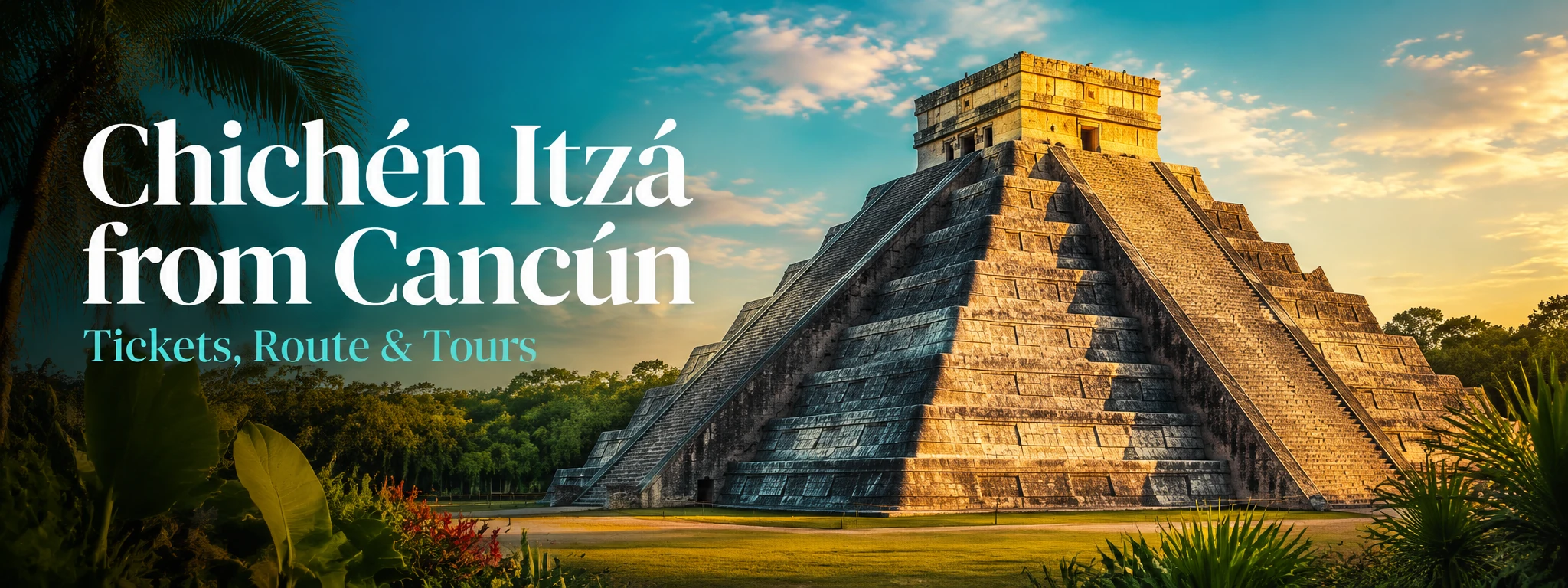

Chichén Itzá is the Yucatán Peninsula's headline archaeological site, but a good visit is much more than standing in front of El Castillo for ten minutes. The city developed over many centuries, combines Maya traditions with influences from central Mexico, and preserves a huge ceremonial landscape that includes the Great Ball Court, Temple of the Warriors, Sacred Cenote, El Caracol and older southern complexes. It is a long but very manageable day trip from Cancún if you make the key decisions — transport, arrival time and route — before you leave.
Quick planning answer: allow a full day from Cancún. The official INAH visitor page currently lists general public hours of 08:00–16:00 with last access at 15:00, and it separately notes a Yucatán state tourism fee on top of the federal INAH admission. Those figures and hours can change for equinox operations, conservation work or special events, so verify them on the official site shortly before travelling.
Is Chichén Itzá worth the long day from Cancún?
Yes, if you are genuinely interested in Maya history or want one major inland excursion. The site is UNESCO World Heritage-listed and is unusually rich in both scale and variety: monumental plazas, religious architecture, ball courts, carved reliefs, a sacred water source and structures reflecting different phases of the city's development. If your priority is simply a quick ruins-and-beach combination, Tulum is much easier. If you want the most substantial archaeological day from Cancún, Chichén Itzá is the stronger choice.
How far is Chichén Itzá from Cancún?
Road distance is roughly 200 km depending on your starting point and route. In real trip planning, think in terms of about 2½ to 3 hours each way, not a guaranteed drive time. Hotel pickups, traffic leaving Cancún, toll-road stops and tour collections can all stretch the journey. That is why a Chichén day should not be treated like a half-day excursion.
Current opening hours and admission: what to know
INAH's current Chichén Itzá listing shows daily opening from 08:00 to 16:00 and last access at 15:00. It also lists an INAH admission component of MXN 105 and a separate CULTUR/State of Yucatán tourism-parador charge — currently MXN 548 for foreign visitors and MXN 190 for Mexican nationals, with Yucatán residents exempt from that state component. In practice, foreign visitors should therefore expect the published components to add up to more than the headline INAH figure alone.
Do not build your budget around a screenshot from a reseller or an old blog. Check the official INAH Chichén Itzá visitor page for the latest hours, admission components and site rules before you go. Equinox dates can have special operating arrangements and crowd controls.
The best time to arrive
Opening time is the sweet spot. It gives you cooler conditions, cleaner sightlines around El Castillo and more time to explore before the midday heat. INAH currently notes preferential agency attention from 11:00 to 14:00, which neatly overlaps with the period when many organised groups are on site. If you are self-driving, arriving around opening is the simplest advantage you can give yourself.
If you can only arrive later, do not panic: the site is large enough to move beyond the most photographed plaza. But carry water, use sun protection and pace yourself. There is limited shade in several major open areas and the heat can be draining.
A smart route through the archaeological zone
For a first visit, start with the northern monumental group while your energy is high. See El Castillo, then walk to the Great Ball Court and its associated temples. Continue toward the Temple of the Warriors and Group of the Thousand Columns. From there, decide whether to follow the sacbé toward the Sacred Cenote before working south toward El Caracol, the Nunnery complex and other older structures.
This order is not mandatory; it is simply a practical way to see the iconic northern monuments before crowds thicken, while still leaving time for the less-rushed southern sector. Avoid treating the site as a photo checklist. The change in architectural language as you move through different groups is part of what makes Chichén Itzá historically important.
El Castillo: what you are actually looking at
El Castillo, or the Temple of Kukulcán, is the stepped pyramid at the centre of the main northern plaza. INAH describes it as a 30-metre-high, nine-platform monument whose four stairways contain 91 steps each; together with the upper platform, that symbolism is commonly read as 365. Around the equinoxes, angled sunlight creates the famous descending-serpent shadow effect on the balustrade.
The important practical point is that visitors do not climb El Castillo. The monument is observed from ground level as part of a protected archaeological zone. Any tour advertising modern-day pyramid climbing is using outdated imagery or misleading copy.
The Great Ball Court is not a side attraction
Chichén Itzá's Great Ball Court is one of the site's most impressive spaces. INAH identifies it as the largest ball court at the complex, with high parallel walls, stone rings and associated temples. Its reliefs and architecture show that the ball game was not merely sport: it had ritual and political meaning. Spend a few minutes looking at the carved panels rather than walking straight through to the next photo stop.
Temple of the Warriors and the Thousand Columns
The Temple of the Warriors and surrounding colonnades make the Maya–central Mexican blend especially visible. UNESCO highlights Chichén Itzá as an important example of Maya construction combined with elements associated with central Mexico. The complex is a good place to slow down and notice repeated warrior, serpent and other carved motifs rather than focusing only on the pyramid.
The Sacred Cenote and why water mattered
Chichén Itzá developed beside natural limestone sinkholes that supplied access to groundwater; UNESCO notes that these cenotes are central to both the city's name and settlement. The Sacred Cenote north of the main plaza was also a ritual place. It is not a swimming stop. If you want to swim in a cenote, plan a separate visit to a managed site such as one of the cenotes around Valladolid or Puerto Morelos.
El Caracol and the southern group
El Caracol's circular upper structure is one of Chichén Itzá's most recognisable buildings after El Castillo. UNESCO specifically identifies it among the surviving monuments that illustrate the city's Maya–Toltec cultural blend. Nearby southern complexes contain architecture associated with earlier phases of the city, making this part of the site worth the extra walking even when the main plaza has already delivered the famous views.
Guided tour or self-drive?
Choose a tour if you want the easiest logistics, historical interpretation and a fixed itinerary. A good guide can help turn carved details and spatial relationships into a coherent story. Check exactly what the advertised price includes: site admission, the separate state fee, lunch, cenote entry and hotel pickup are not automatically included in every product.
Drive yourself if arriving at opening and controlling your pace matter more than convenience. The official INAH access note directs visitors from Cancún or Mérida via Federal Highway 180 toward Pisté. Self-driving works particularly well if you want to combine the site with Valladolid or choose your own cenote rather than the one attached to a group itinerary. Read our Cancún car-rental guide before committing to the drive.
Can you visit by public transport?
Intercity coach options vary by date and season, and timetables are far less forgiving than having your own vehicle or tour. If you plan to use a bus, verify the current operator schedule in both directions before the day of travel and leave plenty of buffer before the archaeological zone closes. Do not assume a late return will always be available just because one appeared in an old forum post.
Should you combine Chichén Itzá with a cenote?
Yes, but be realistic about your energy. A cenote swim is a refreshing counterpoint to several hours walking through exposed archaeological plazas. Ik Kil is only about 3 km from Chichén Itzá according to Yucatán's official tourism site, which makes it an easy pairing but also a popular one. Other Valladolid-area cenotes can make sense if you are self-driving and prefer a different atmosphere.
For a more relaxed day, add Valladolid for a meal or overnight stay instead of cramming two or three attractions into a race. Our Cancún day-trips guide compares the overall effort with Tulum, Isla Mujeres and other alternatives.
What to bring
- Comfortable shoes with grip — this is a large outdoor archaeological site, not a paved museum.
- Water and sun protection suitable for a hot, exposed day.
- Light clothing and a hat.
- Enough payment flexibility for admission components, food and transport.
- A small bag rather than unnecessary luggage; INAH lists lockers and cloakroom services but travelling light is easier.
- If combining with a cenote, swimwear and a towel kept separate from your dry clothes.
Accessibility and site rules
INAH lists accessibility services, parking, toilets, information, guided visits, lockers and cloakroom facilities. That does not mean every archaeological surface is effortless for every mobility need: expect distance, heat and uneven ground. The official listing also prohibits smoking, food, pets and flash photography, and notes a separate rule for professional cameras. Check current conditions if accessibility is central to your visit.
Common planning mistakes
- Arriving at noon: you hit the strongest heat and the busiest group-tour window at the same time.
- Budgeting only the federal fee: the official page separately lists the Yucatán tourism charge.
- Assuming you can climb the pyramid: you cannot.
- Overpacking the day: Chichén Itzá, a cenote, Valladolid and another major stop can turn a memorable trip into a transport marathon.
- Skipping historical context: without a guide or some reading, the visit can collapse into “big pyramid, ball court, bus home.”
Official sources and further reading
- INAH — Chichén Itzá visitor information, hours, fees and rules
- INAH — Chichén Itzá monuments and interpretation
- UNESCO World Heritage Centre — Pre-Hispanic City of Chichén-Itzá
Verified 30 August 2026. Recheck the official INAH page before travel because operating hours, special-event controls and fees can change.