

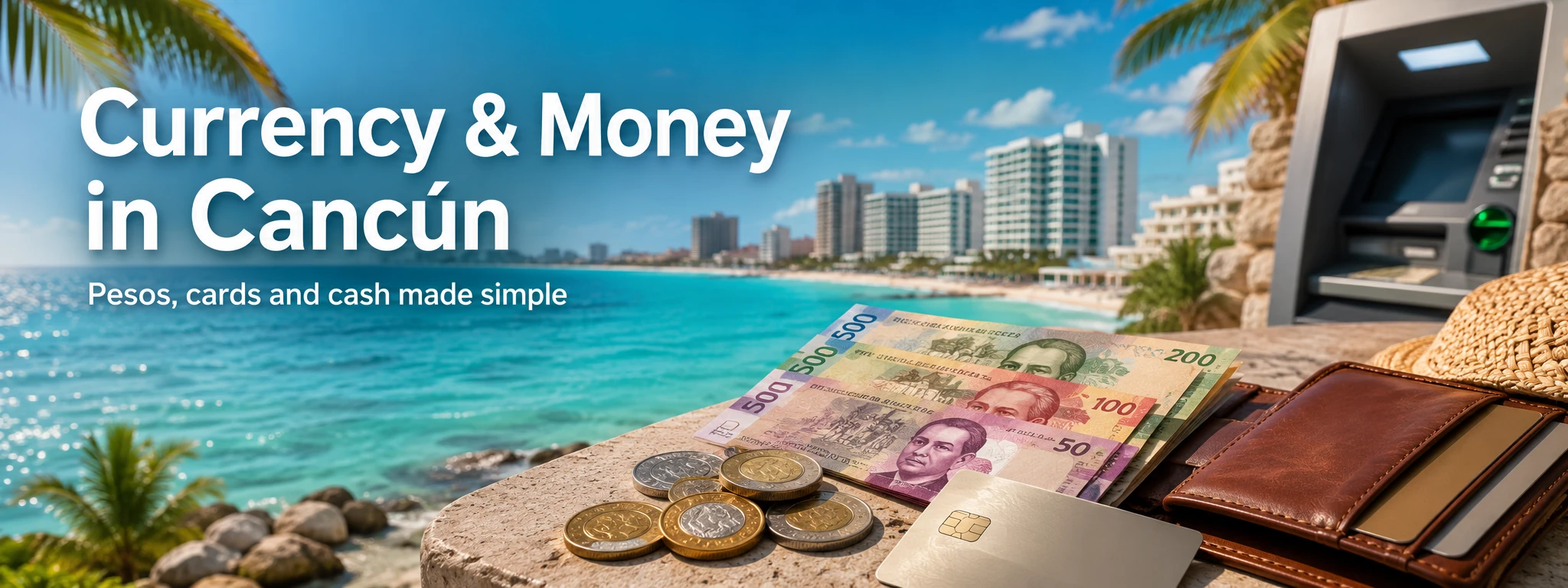

Mexico's currency is the Mexican peso (MXN), and planning in pesos is the simplest way to understand what you are actually spending in Cancún. Tourist businesses may display or accept US dollars, especially in the Hotel Zone, but dollar acceptance is a convenience offered by the merchant — not a reason to stop thinking in pesos. The exchange rate used at the counter may be less favourable than your card or a sensible peso withdrawal.
Quick answer: use pesos as your default local currency, carry a modest amount of cash in useful denominations, pay by card at reputable businesses when convenient, use bank-associated ATMs rather than random standalone machines where possible, and read every currency-conversion screen before accepting it.
Why pesos should be your default
Menus, official fees and local prices are fundamentally peso prices. Paying in another currency makes it harder to compare businesses because each merchant can use a different conversion. If a restaurant displays both MXN and USD, compare the peso total rather than assuming the dollar figure tracks the market rate.
Banco de México publishes official exchange-rate/reference information, but the rate your bank/card applies can differ because of network timing and fees. Treat the central-bank figure as context, not a promise of the exact retail conversion you will receive.
Cash vs card
| Use card when… | Keep cash for… |
|---|---|
| Hotel, established restaurant, supermarket or larger attraction | Small vendors, tips you choose to give, local transport situations |
| You want a transaction record | Backup if a terminal/network fails |
| Your card has reasonable foreign-use terms | Small purchases where card acceptance is uncertain |
Do not carry your entire holiday budget in cash. Split cards/cash and keep a backup payment method separate from your everyday wallet.
ATMs: focus on total cost, not the first fee shown
A withdrawal can involve the local ATM fee plus your own bank's international ATM/foreign-exchange charges. Before travelling, check your bank's terms so you know whether several small withdrawals or fewer larger ones make more sense.
Prefer machines associated with established banks and use locations where you can put cash away discreetly. If an ATM feels tampered with, the card slot/keypad looks unusual, or anyone offers unsolicited “help”, cancel and use another machine.
Dynamic currency conversion: read the choice
Some ATMs/card terminals offer to convert the transaction into your home currency. This is commonly called dynamic currency conversion. The screen may make the home-currency option look reassuring because you recognise the amount, but it can include a conversion rate/markup set by the provider.
Compare the offered conversion before accepting it. If you choose to be charged in pesos, your card issuer/network handles the conversion under its own terms. Know your bank's fees so you can make an informed choice rather than automatically pressing the first highlighted button.
Should you bring US dollars?
You do not need USD for an ordinary Cancún holiday if you have workable cards and access to pesos. Some travellers like a small emergency reserve, and some tourist businesses accept dollars, but bringing a large stack of USD can create unnecessary exchange-rate decisions.
If you are arriving with another home currency such as AUD, GBP, EUR or CAD, there is usually little logic in converting it to USD first and then converting again to MXN unless your specific banking situation makes that cheaper.
Cash exchange offices
Exchange houses can be useful, but compare the final rate and any commission rather than a large sign saying “no fee”. Ask how many pesos you will receive for the exact amount you are exchanging before handing over cash.
Count the money at the counter and keep the receipt. Avoid carrying large sums away openly.
Hotel/resort exchange convenience
A hotel desk may exchange currency because it is convenient, not because it offers the best rate. For a small urgent amount, convenience can be worth something. For a substantial exchange, compare it with other legitimate options first.
Restaurant bills: check the currency and total
Before paying, make sure the bill is in the currency you expected and review unfamiliar charges. Profeco's consumer guidance says prices should be clearly displayed and reminds consumers that tipping is voluntary — establishments cannot require or set a mandatory tip.
If a terminal asks for a tip separately, read the screen. Do not let social pressure rush you through an amount you did not choose.
Tipping: voluntary, not a hidden mandatory fee
Profeco reiterated in May 2026 that tips are voluntary in restaurants, bars, tourism services and hotels. Travellers can still choose to tip for good service; the important point is that a business cannot force a percentage or unilaterally include a compulsory tip as though it were a required charge.
If you like to tip housekeeping, guides, drivers or restaurant staff, budget for it deliberately and carry suitable peso notes rather than relying on USD simply for tips.
Card surcharges and unexpected fees
If a business adds an unexpected card charge, ask what it is before paying and request a receipt. Profeco's consumer guidance has specifically warned against abusive/unannounced charges and emphasises respecting displayed prices.
Keep the merchant copy/screenshot for significant transactions, especially tours, deposits and hotel extras.
Deposits and hotel holds
Hotels and rental companies may place a temporary authorisation/deposit on a card. Ask the amount and release process at check-in or booking. A hold can reduce your available credit even though it is not yet a final charge.
Using a card with enough headroom avoids having your daily-spending card unexpectedly constrained.
Rental cars and cards
Car-rental deposits, insurance choices and card requirements can be more significant than the advertised daily vehicle rate. Confirm accepted cards, deposit amount, insurance terms and the final payable total directly with the rental provider before arrival.
See our Cancún car-rental guide before booking a low headline rate.
Public transport and small cash
Local buses/colectivo-type transport can make small-denomination pesos useful. Do not rely on a large note being easy to change. Keep a small separate transport amount so you are not pulling out your full wallet each ride.
For airport/Hotel Zone connections, see our getting-around guide and airport transfer guide.
Excursions: compare what the price includes
A tour price can exclude conservation/park fees, equipment, meals, pickup zone or photos. Ask for the final total in MXN and what remains payable on the day. This is especially important for marine trips and archaeological excursions where multiple legitimate fees can exist.
Markets and bargaining
Some souvenir-market purchases may be negotiable; supermarkets, restaurants, ticket offices and normal fixed-price shops are not. Bargain politely where it is actually part of the sales culture, and walk away if the final price is not worth it.
Do not let a salesperson switch the agreed currency at payment time. Repeat the final total and currency before card/cash changes hands.
Safety with money
- Carry only the cash needed for the day.
- Keep a backup card separately.
- Use secure ATMs and put money away before leaving.
- Shield PIN entry.
- Turn on transaction alerts where available.
- Do not hand a card to an unknown person who walks away from you if portable payment is possible.
- Check statements while travelling so unusual charges are noticed early.
What to do if a card is lost
Freeze/lock it through your banking app if possible, contact the issuer, and use your backup. Keep international bank contact details somewhere other than the lost wallet/phone. If your phone itself is lost, know how you will access two-factor authentication or emergency funds.
Build a simple Cancún money system
- Budget the trip in MXN.
- Use one main card with known foreign-use terms.
- Carry a second card separately.
- Withdraw/use a modest peso cash float.
- Keep small notes for transport/tips.
- Review bills and conversion screens before confirming.
- Replenish cash deliberately rather than carrying a huge amount from day one.
Common money mistakes
- Thinking USD acceptance means USD gives the best rate.
- Accepting an ATM/card conversion without reading the markup/rate.
- Using standalone ATMs without considering total fees/security.
- Carrying all cards and cash together.
- Letting a restaurant add a compulsory “tip” without questioning it.
- Comparing tour/hotel prices before taxes/fees/deposits are clear.
- Converting home currency to USD and then to MXN without checking the double conversion cost.
💵 Best money rule
Make pesos your mental unit. Once every local purchase is compared in the same currency, exchange-rate tricks and “special tourist prices” become much easier to spot.