

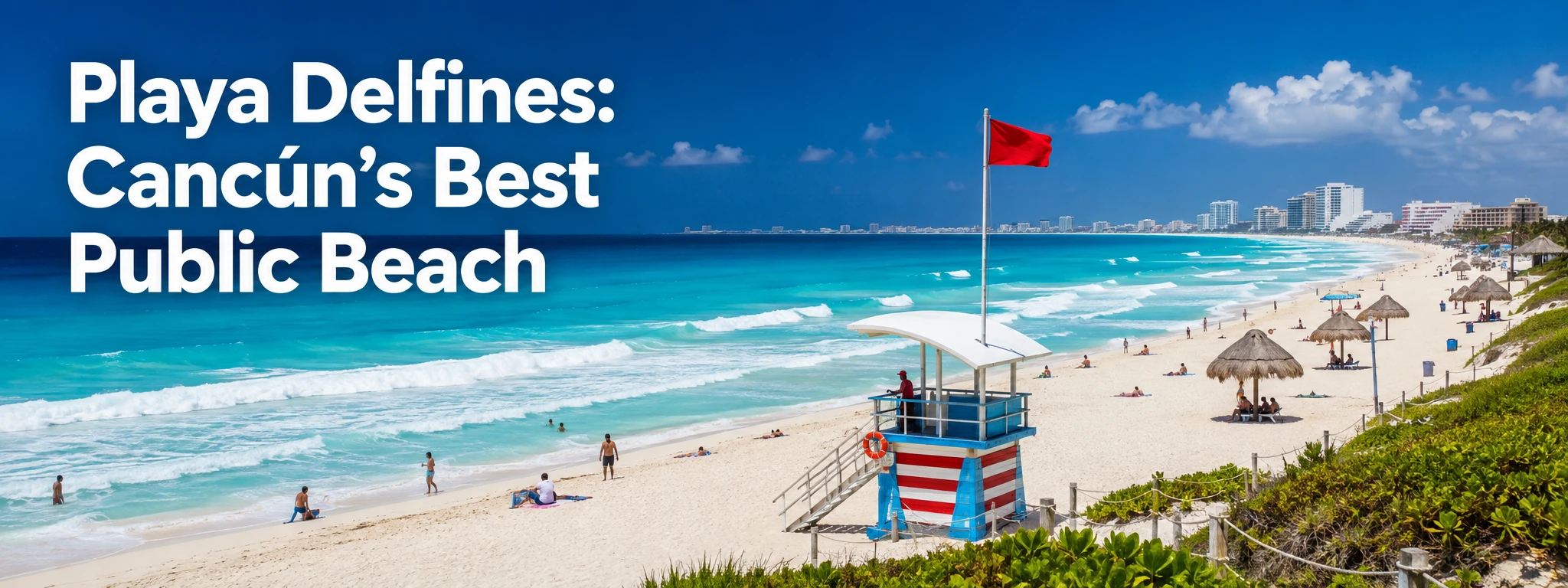

Playa Delfines is Cancún's best-known public beach for a reason: it gives you a broad sweep of open Caribbean sand without needing a resort day pass. It sits around kilometre 17 of Boulevard Kukulcán, toward the southern end of the Hotel Zone, and is also known locally as El Mirador.
The useful thing to know before you go is that “public” does not mean “calm”. Delfines faces the open Caribbean, so waves and rip-current risk can be much stronger than at some north-facing beaches. Treat the beach flag and lifeguard instructions as the decision-maker for swimming, not how inviting the water looks from the sand.
Why choose Playa Delfines?
Choose it for space, a non-resort atmosphere, a classic Caribbean view and easy public access. It is especially useful if your hotel's beach feels cramped, heavily built-up or affected by conditions you do not like that day. It is also one of the easiest places to get the famous colourful CANCÚN-letter photo without entering a private property.
Benito Juárez municipality lists Delfines among its municipally managed public beaches and, in 2026, reported that it retained Blue Flag status alongside six other public beaches. That certification is useful evidence of managed services and environmental standards, but it is not a promise of calm water on any particular day.
Access is free
Municipal public beaches are free to enter. You do not need to buy food, rent a chair or hold a hotel reservation to use Delfines. If someone tries to turn ordinary beach access into a compulsory purchase, distinguish that from a genuine optional rental or commercial service.
The municipality has also highlighted free parking, toilets/showers, signage, waste facilities, lifeguard towers and accessibility features at its certified public beaches. Services can be busier, temporarily unavailable or operating on different hours outside peak periods, so do not plan a tight day around one facility being guaranteed.
Check the beach flag before swimming
Make the flag your first stop after arriving. Cancún's municipal safety messaging repeatedly tells swimmers to follow the posted colour system and lifeguard instructions. Open-Caribbean surf can create powerful currents even when the sky is clear.
- If lifeguards restrict swimming, do not negotiate with the sea. A beach day can still be worthwhile for the sand and view.
- Keep children close to shore and within arm's reach when conditions allow swimming.
- Do not use an inflatable toy as safety equipment. Wind and current can carry it away from shore quickly.
- After storms or rough-weather days, expect conditions to change. Check again rather than relying on yesterday's report.
Smartraveller's Mexico advice also warns that undertows and currents can endanger even strong swimmers and tells travellers to follow beach warning flags. Our broader Cancún swimming and beach-safety guide explains how to choose a beach by conditions rather than reputation.
Use the official beach-condition tools
Cancún has been strengthening a municipal public-beach dashboard designed to show current conditions. Check official local information close to departure, particularly if swimming is the main reason for your visit. A generic weather app cannot tell you what the surf, flag or sargassum looks like at one specific stretch of coastline.
Lifeguards are a major advantage — not a guarantee
Municipal reporting in 2026 described permanent lifeguard coverage at public beaches, with reinforced staffing during busy holiday periods. That makes Delfines a better-informed choice than an unsupervised patch of coast, but lifeguards cannot make dangerous water safe. Stay in supervised areas and obey closures or restrictions immediately.
What facilities should you expect?
Delfines is more developed than a remote beach but it is not a resort. Think public-beach infrastructure rather than pool-club service. Bring drinking water, sun protection and whatever you need for several hours instead of expecting a waiter, locker room or guaranteed rental inventory.
- Public access and municipal beach management.
- Parking, with capacity that can fill at popular times.
- Toilets and shower facilities associated with the public-beach service area.
- Lifeguard and safety signage.
- Waste bins and municipal cleaning.
- Accessibility infrastructure at the certified public-beach facilities, though soft sand remains a practical barrier once you leave hard surfaces.
Getting there without a car
Delfines is on Boulevard Kukulcán, the road running the length of the Hotel Zone. Hotel Zone buses are usually the simplest public-transport approach for visitors staying along the strip; tell the driver or watch your map so you can get off near Playa Delfines. If you are travelling from downtown, factor in the connection and extra journey time rather than treating it like a short walk from El Centro.
A taxi or app-based ride may be simpler for a family carrying beach gear, but confirm the pickup plan before leaving your hotel. At busy beaches, the trip home can matter more than the trip there. See getting around Cancún for the wider bus/taxi context.
Driving and parking
Free public parking is one of Delfines' attractions, but “free” does not mean “unlimited”. Arrive earlier if parking matters, especially on weekends and holiday periods. Do not leave passports, cash or visible luggage in a parked vehicle just because the car park is beside a famous beach.
Sargassum can affect Delfines too
Delfines is not permanently sargassum-free. The open coast can receive substantial seaweed depending on winds, currents and the wider Caribbean season. In June 2026 the municipality reported ongoing sargassum-removal work at public beaches, including maintenance at Delfines. That is evidence of active management, not a reason to promise pristine sand every morning.
If seaweed matters strongly to you, check current reports and compare more than one beach on the day. Our sargassum guide explains why a month-by-month guarantee is misleading.
Sun and heat are part of the safety plan
The wide, bright beach has limited natural shade. Pack a hat, high-SPF sunscreen, water and a cover-up. Midday heat can be draining, particularly for young children, older travellers and anyone arriving straight from a cooler climate. An early beach session followed by lunch or indoor time is often more comfortable than trying to “get value” by staying through the hottest hours.
Families: great sand, variable swimming
Families can love Delfines for the space and straightforward public access, but choose it for the beach, not because you assume toddlers will have calm water. If the flag or surf makes swimming unsuitable, switch the plan rather than pushing through. A north-facing or more sheltered alternative may be better on a rough day.
Accessibility: better infrastructure, difficult sand
The municipal Blue Flag programme includes accessibility criteria and the city promotes universal-access features at certified public beaches. Still, the transition from hard surface to deep sand and then to the water is the part that varies most for travellers with mobility needs. If beach access is essential, check the current setup before travel and consider going with a companion rather than relying on generic “accessible beach” wording.
What to bring
- Drinking water and a refillable bottle.
- Reef-conscious sun protection, hat and rash shirt.
- A towel or beach mat and a compact shade solution if you need one.
- A waterproof pouch for phone, cards and room key.
- Footwear for hot pavement and facilities, even if you go barefoot on the sand.
- Very little valuable gear: a public beach is easier when you are not guarding a pile of electronics.
How long do you need?
Two to four hours is enough for most visitors who want the sign, a swim when conditions allow and some beach time. Make it a full day only if you genuinely enjoy long beach sessions. Delfines combines easily with other southern Hotel Zone stops, but do not overload the schedule if you are carrying wet gear and relying on buses.
When to skip Delfines
Skip or shorten the visit if the official flag indicates unsafe water and your only goal is swimming, if current sargassum conditions are poor and beach appearance matters to you, or if you need resort-level shade and service. Cancún has multiple public beaches; the “best” one is the one that matches today's sea conditions and your needs.
🏖️ Best rule for Playa Delfines
Go for the space, public access and Caribbean view. Decide whether to swim only after you arrive and check the official flag and lifeguard guidance.