

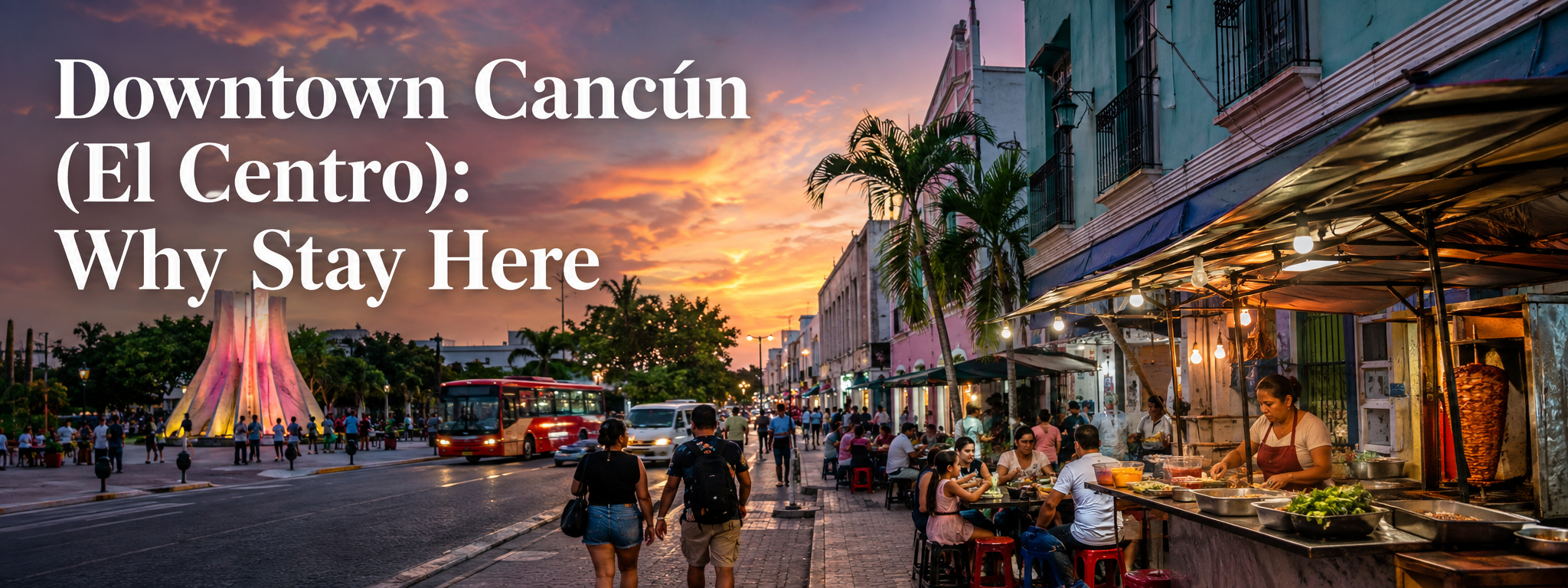
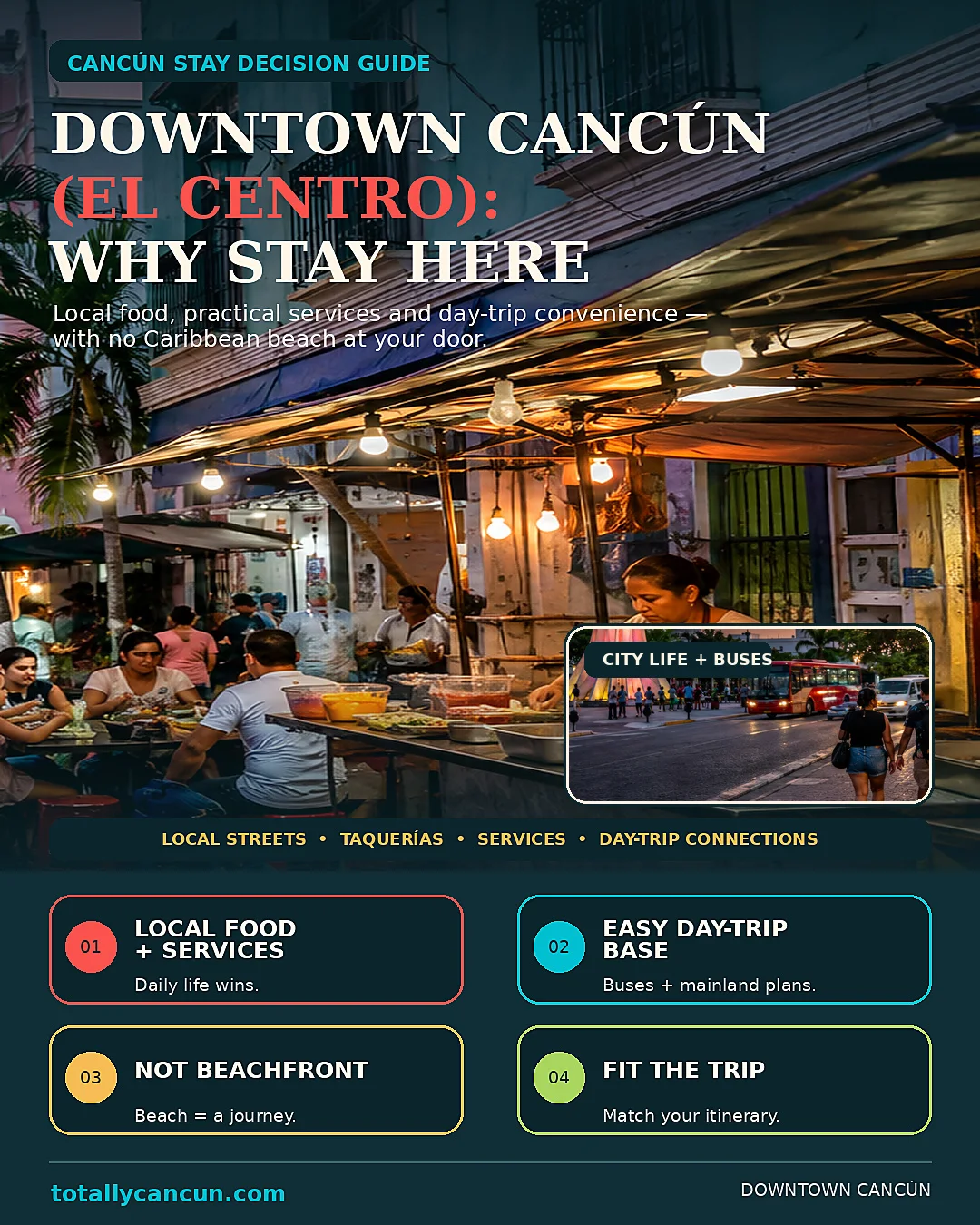
Downtown Cancún — usually called El Centro by visitors — is the mainland city west of the Hotel Zone. It is where Cancún functions as a working city rather than primarily as a resort corridor: local restaurants, supermarkets, pharmacies, bus connections, public squares, offices and everyday neighbourhoods are mixed with hotels and visitor services. Staying here can make a Cancún trip cheaper, more flexible and more connected to local life, but it changes the holiday. You will not step from your hotel directly onto the Caribbean beach.
Quick answer: choose downtown if you value local food, practical services, day-trip transport and a city base more than resort-beach convenience. Choose the Hotel Zone if most days revolve around the sea, pool, resort restaurants and late-night Hotel Zone entertainment. For many travellers, the best decision is not “which area is better?” but which area removes the most daily friction from the trip you actually plan to take.
Downtown Cancún and the Hotel Zone are different kinds of holiday
| Priority | Downtown / El Centro | Hotel Zone |
|---|---|---|
| Beach at the door | No | Often yes or very close |
| Local restaurants and everyday services | Excellent choice | More visitor-oriented |
| Public transport / intercity connections | Very convenient for many routes | Convenient along Boulevard Kukulcán |
| Resort atmosphere | Limited | Main reason to stay |
| Independent day trips | Often easier | May require pickup/transfer planning |
| Nightclub strip | Not on your doorstep | Punta Cancún is the main cluster |
| Longer stay / errands / groceries | Usually practical | Possible, but less city-like |
If you are still deciding, compare this guide with our Hotel Zone guide. Compare the whole trip rather than just the room rate.
Where “downtown” actually means
There is no single tourist gate where downtown begins. For a first-time visitor, the most useful central reference points are Parque de las Palapas, Avenida Tulum, Avenida Uxmal, the ADO bus-terminal area, Mercado 28 and the routes leading north towards Puerto Juárez. Accommodation advertised as “downtown Cancún” can be several kilometres apart, so check the pin on a map rather than trusting the neighbourhood label alone.
A hotel a few walkable blocks from Parque de las Palapas can feel very different from an apartment deeper in a residential supermanzana. Before booking, map the exact property to the places you expect to use at night, your preferred bus corridor and any early-morning transport departure.
Parque de las Palapas is the easiest centre-of-gravity
Parque de las Palapas is one of the most useful anchors for understanding central Cancún. The Benito Juárez municipality continues to use the park for public cultural events, family activities, artisan and food programming, and major celebrations. In 2026 municipal event notices repeatedly placed public performances and festivals here, confirming that it remains an active civic space rather than a tourist attraction preserved only for photographs.
That makes the surrounding streets a sensible base for travellers who want casual evening food and activity without having to travel back to the Hotel Zone every night. Events vary by date; do not book expecting a particular performance or market. Treat whatever is on as a bonus and check the municipality's current cultural calendar after arrival.
What downtown evenings feel like
Downtown nightlife is more dispersed than the Hotel Zone's club strip. A typical evening might mean dinner, a walk around Las Palapas, a bar or café, then a short ride back to your accommodation. That suits travellers who prefer lower-key nights and local restaurants. It does not replace Punta Cancún if your main objective is the big resort clubs and entertainment venues.
If you plan several Hotel Zone late nights, include the return journey in the accommodation decision. A cheaper downtown room can lose its value advantage if you repeatedly pay for late transport simply because all of your evening plans are elsewhere.
Food is one of downtown's strongest reasons to stay
The centre gives you far more freedom to eat outside a resort ecosystem. You can mix taquerías, casual Yucatecan and Mexican cooking, bakeries, cafés, food stalls and ordinary restaurants with larger chains and supermarkets. The useful strategy is to explore by area and current menus rather than chase an old “ten cheapest restaurants” list whose prices and opening hours may have changed.
Parque de las Palapas is an easy starting point for casual food, while the wider centre has much more than the park itself. Mercado 28 is well known to visitors for souvenirs and small businesses, but do not mistake a tourist-oriented market for the whole of local Cancún. Walk a few blocks, compare menus and choose places that fit your comfort level and appetite.
Market shopping: browse without assuming every price is a bargain
Downtown is often described online as “local prices”, but that phrase is too broad. Visitor-heavy markets can still price for tourists, and bargaining norms vary by shop and product. Compare before buying, ask the final price clearly and keep the interaction friendly. For everyday purchases, supermarkets, pharmacies and fixed-price shops may be more useful than souvenir markets.
For restaurants and services, Mexican consumer-protection principles still apply: review displayed prices and the bill, and remember that tipping is voluntary rather than a compulsory percentage imposed by the venue. Our Cancún budget guide covers current money and tipping considerations in more detail.
Getting to the Hotel Zone from downtown
Downtown and the Hotel Zone are connected by the main city corridors, with public buses operating between central Cancún and Boulevard Kukulcán. For visitors, the important point is not memorising a route number months before travel; routes, stops and operational details can change. Confirm the current bus direction locally and ask your accommodation which nearby stop is best for your intended beach or Hotel Zone section.
Because the Hotel Zone is long, “going to the beach” is not one destination. Pick the public beach or attraction first, then choose the transport. For beach-focused days, our Cancún swimming and beaches guide explains public-access choices and why current lifeguard flags matter more than old beach reviews.
When a taxi or app ride makes more sense
Public transport is excellent for routine corridor journeys, but a taxi or app-based ride may make more sense when you have luggage, are returning late, are travelling with small children, or your accommodation is awkwardly located relative to a useful bus stop. Availability and pickup practice can differ by location, especially around transport hubs and resort properties, so use the current local rules and your accommodation's advice rather than an old forum thread.
For any taxi journey without a metered/app quote, establish the fare before getting in. Our getting around Cancún guide is the better place for current transport planning.
Airport arrival: downtown is simpler than many resort transfers
If you are staying centrally, the ADO terminal area can make downtown practical for airport and regional travel. Do not assume, however, that every airport bus stops at your hotel or that a terminal arrival eliminates the final local journey. Check your terminal, current ADO service and the distance from the downtown bus station to the property before flying.
If you arrive very late, have heavy luggage or your accommodation is not near the central transport corridor, a pre-arranged transfer may be worth the extra cost. See our Cancún airport transfers guide for the full decision.
Puerto Juárez and Isla Mujeres are a downtown advantage
Travellers planning Isla Mujeres should notice the geography. Ultramar's main Cancún ferry terminal is at Puerto Juárez, north of central Cancún on the mainland. From a downtown base, Puerto Juárez can be more convenient than travelling from the southern Hotel Zone. Ultramar publishes the current terminal and sailing information, so verify your departure point on the official site before leaving.
This is especially useful if Isla Mujeres is a major day trip or you are transferring to an island stay. Read our Isla Mujeres guide before deciding whether to visit for a day or move there for several nights.
Independent day trips can be easier from the centre
Downtown works well for travellers using Cancún as a transport hub rather than staying inside one resort. Intercity buses and organised tours often use central pickup or terminal points, which can simplify trips towards Valladolid, Playa del Carmen, Mérida and other regional destinations. The exact best departure point depends on the trip, so do not book a downtown hotel solely because an old article says “all tours leave from ADO”.
For Chichén Itzá, cenotes and other excursions, compare the official/current meeting point before choosing accommodation. A Hotel Zone pickup included in a tour can be more convenient than travelling downtown at dawn; an independent bus trip may favour the centre.
Walking: useful locally, not a substitute for transport
Central Cancún is more walkable for daily errands than much of the resort corridor, but distances can still be deceptive in tropical heat. A 20-minute map walk can feel very different at midday with little shade. Plan outdoor errands for cooler periods, carry water and use transport when the distance stops being sensible.
Street quality and crossings vary. Do not assume every route has a continuous, obstacle-free footpath. Travellers with mobility needs should ask the property about the immediate block, entrance, lift and route to transport rather than relying on a generic “downtown is walkable” label.
Safety: use city habits, not resort assumptions
Downtown is a functioning city, and the sensible precautions are familiar: keep valuables controlled in busy places, use well-lit routes at night, avoid flashing large amounts of cash, and choose transport you are comfortable with after drinking. Do not treat a lively public square as evidence that every surrounding street is equally busy late at night.
Accommodation quality and exact location matter more than the word “Centro”. Read recent reviews for street noise, night access and reception/security arrangements. For broader current risk context and emergency planning, use our Cancún safety guide.
Families: downtown can work, but plan the beach days
Families can benefit from larger rooms/apartments, supermarkets, casual food and practical services downtown. The compromise is repeated transport for beach and resort activities. With younger children, that daily transfer may be more tiring than the accommodation saving is worth.
Downtown makes most sense for a family whose itinerary mixes excursions, Isla Mujeres, local meals and only selected beach days. If the children primarily want sand, pool and easy room breaks, a beach-area base is usually simpler.
Solo travellers and longer stays
Solo travellers often get more value from the centre because they can use public transport and casual restaurants without paying resort-area premiums designed around couples or package guests. Longer stays also benefit from groceries, laundry, pharmacies, gyms, cafés and the feeling of having a usable neighbourhood rather than a holiday compound.
But check the exact property carefully. A highly rated hostel near the centre and an isolated budget apartment advertised as “downtown” can offer completely different levels of convenience.
Do not book downtown just because the room is cheaper
Calculate the total trip pattern. Add the likely cost and time of beach transfers, late-night returns, airport movement and any resort-area activities. Then compare that with the value of local meals, a lower room rate, easier errands and central transport. The cheapest room is not the cheapest trip if it creates four extra journeys every day.
Conversely, do not pay a Hotel Zone premium if you will spend most days on inland excursions and most evenings eating in town. Match the accommodation to where your time will actually go.
A simple booking checklist
- Map the exact address: not just “Cancún Centro”.
- Check your night routine: can you comfortably return after dinner or nightlife?
- Map a beach day: choose one real public beach and test the journey.
- Map your transport day: ADO terminal, airport transfer or tour meeting point.
- Check basics: air-conditioning, hot water, lift if needed, reception hours, luggage storage and noise comments.
- Read very recent reviews: focus on the street and access, not only the room.
- Compare total cost: room + routine transport + food pattern + beach/resort extras.
Bottom line: who should stay downtown?
Stay downtown if you want Cancún to function as a real city base: local food, everyday services, regional transport, Isla Mujeres access and a more independent trip. Stay in the Hotel Zone if the Caribbean beach, resort facilities and visitor entertainment are the main event and you want them immediately outside the hotel.
A split stay can also work for longer trips: several resort nights for easy beach time, then downtown or another mainland base when the itinerary shifts towards excursions and local life. What matters is reducing unnecessary back-and-forth rather than proving that one side of Cancún is “more authentic” than the other.
Current sources checked
- Municipio de Benito Juárez — July 2026 Guelaguetza route and Parque de las Palapas event.
- Municipio de Benito Juárez — August 2026 public event at Parque de las Palapas.
- Municipio de Benito Juárez — Parque de las Palapas public-space programme.
- Ultramar — current Puerto Juárez / Isla Mujeres terminal and ferry information.